
Research

Advancing energy solutions through interdisciplinary research and strategic partnerships
Research
The Energy Institute engages in collaborative research involving multiple disciplines within the university as well as external stakeholders—policymakers, community members and industry representatives—to identify the relevant issues or challenges that merit further study.
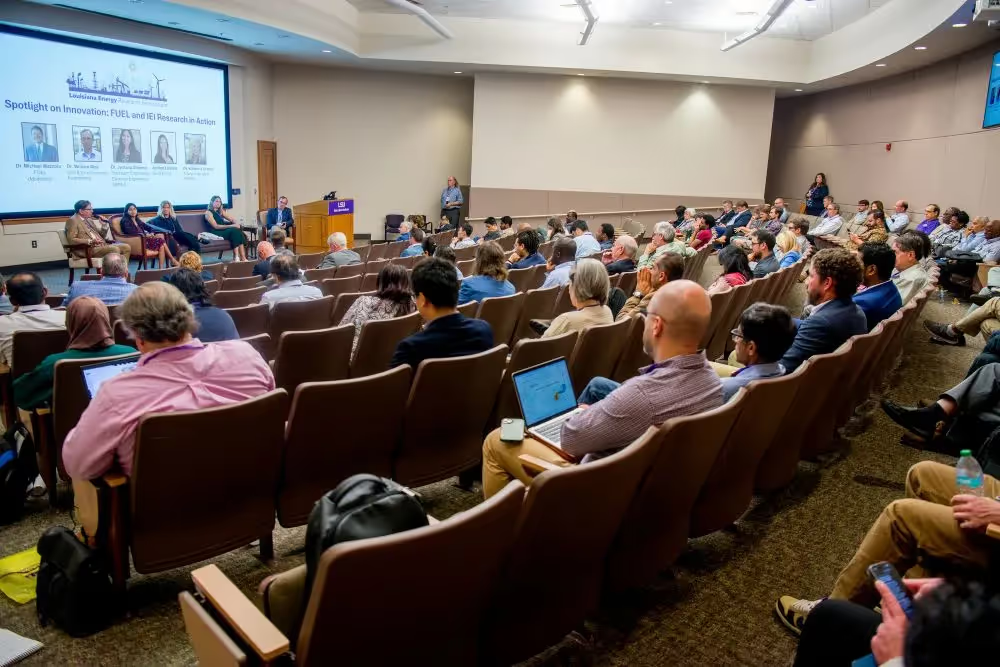
Louisiana Energy Research Symposium 2025 event banner
Through interdisciplinary collaboration, LSU researchers integrate diverse perspectives, expertise, and methodologies to address complex questions that demand a multifaceted approach. This collaborative model enables deeper and broader exploration of each topic, as different disciplines contribute complementary insights and pathways toward innovative solutions.

LSU is a land-grant university, which means we place a high value on applied research to solve real-world problems. By involving stakeholders from the outset, our work fosters mutual learning and shared knowledge that can lead to more effective and sustainable solutions.
Recent White Papers & Studies
Filter By Areas
Energy Education & Outreach
Louisiana Geological Survey
Energy Innovation
Energy Information & Data
Energy RD&D
Energy Policy
Energy Law
Filter By Year
2023
2024
2025
Clear Filters
Category 1
Legal and Regulatory Considerations for Carbon Sequestration Fee Structures

This white paper examines the legal and regulatory issues that arise when developing carbon capture and storage (CCS) projects, with a focus on Louisiana and comparisons to broader U.S. practices. Because CCS requires injecting carbon dioxide deep underground, operators must secure rights to use subsurface pore space—an area of law that is still evolving and differs in key ways from traditional oil and gas activity.

The paper explains why CCS developers need legal rights to pore space, touching on foundational property law concepts like ad coelum and the risk of trespass if injected CO₂ migrates beyond a project boundary. It reviews the types of agreements used to obtain pore space rights (e.g., leases, servitudes) and the compensation models associated with them. It also discusses statutory tools—such as unitization and eminent domain—that may be used when private agreements with all landowners cannot be reached.

Download PDF
2025
Energy Law
Energy Policy
This is some text inside of a div block.
The Gulf Coast Energy Outlook 2026

The LSU Center for Energy Studies released the 2026 edition of the Gulf Coast Energy Outlook (GCEO) annual report on December 10, 2025. The annual report provides an analysis of the Gulf Coast's energy landscape and its trajectory through the upcoming year.

Download PDF
2025
Energy RD&D
Energy Policy
This is some text inside of a div block.
Wind-Resilient Solar - Harnessing CFD for Enhanced Load Estimation
2025
Energy Innovation
Energy RD&D
This is some text inside of a div block.
Advancing Solar Farm Resilience – CFD-Driven Wind Load Optimization
2025
Energy Innovation
Energy RD&D
This is some text inside of a div block.
The Potential for Hydrogen in Louisiana

This paper discusses the different types of hydrogen, their production processes, and current and potential future uses in Louisiana while considering its potential as a low-carbon emission fuel. Low carbon or “clean hydrogen” is the focus of the Internal Revenue Service (IRS) Section 45V production tax credit which has led to additional interest in hydrogen production in Louisiana. The authors estimate that the amount of hydrogen currently used in Louisiana is ~2.4 million metric tons each year, primarily for petrochemical production. Results suggest the potential for hydrogen at approximately 13 times that amount from additional uses, chiefly from energy exports. The Greater New Orleans Development Foundation (GNODF) commissioned LSU-CES to study the potential for hydrogen consumption in Louisiana through the H2theFuture initiative. H2theFuture is a 25-organization partnership led by GNO, Inc. and GNODF, funded by a federal grant from the U.S. Economic Development Administration.  GNODF was provided the opportunity to review and provide feedback on this report. The analysis and opinions expressed are those of the authors alone.

Download PDF
2025
Energy Innovation
This is some text inside of a div block.
The Biofuels Landscape in Louisiana

This paper discusses biomass types and availability in the state, drawing from an analysis of the US Department of Energy’s Billion Ton 23 report, followed by an assessment of current and potential future biofuels production in Louisiana. Louisiana leads the nation in the production of renewable diesel, and biofuels contribute ~4.2% to primary energy production in the state. Deployment of announced biofuels projects has the potential to increase this contribution to ~9.2%. Production of sustainable aviation fuel (SAF) is likely to see an increase in the state with several project announcements focusing on this fuel. Based on the US Department of Energy’s SAF Grand Challenge target (producing 35 billion gallons by 2050 in the US), the state can meet between 1 and 3% of this target in the near term and mature-market medium terms of biomass production from BT23. The contribution of biofuels to energy generation in the state is likely limited to specific transportation applications such as aviation, maritime, long-haul trucking, etc. Sustainable deployment of biofuels is not without challenges and concerns, and some of these are identified in this white paper, along with a consideration of strengths, weaknesses, opportunities, and threats (SWOT) for the industry in Louisiana.

Download PDF
2025
Energy Innovation
This is some text inside of a div block.
The LSU Local Engagement, Assessment and Planning Model

This white paper introduces the LSU Local Engagement, Assessment and Planning Model (LEAP), a systematic framework designed to facilitate community engagement around new energy investments in Louisiana. LEAP aims to provide high-quality, transparent information to help align business goals with community development priorities while building trust between energy companies and local residents. The model consists of four chronological components: Structured Listening (focus groups and workshops to understand community perspectives and priorities), Project and Community Mapping (using GIS technology to visualize proposed projects relative to community features), Economic and Tax Impact Modeling (assessing local costs and benefits using LSU's Louisiana Economic Impact Model), and Communication Back to Community (sharing findings through workshops and educational resources). LEAP was developed by LSU's Center for Energy Studies and Institute for Energy Innovation in collaboration with faculty from Environmental Sciences and Sociology departments. While initially focused on decarbonization investments, the framework is adaptable to various project types. The model emphasizes LSU's role as a neutral third party providing technical information rather than advocacy, supporting the university's mission to enhance Louisiana residents' lives through evidence-based, policy-relevant research and community engagement.

Download PDF
2025
Energy Education & Outreach
This is some text inside of a div block.
Orphan and Idle Wells in Louisiana

Researchers at LSU were commissioned by the Louisiana Department of Energy and Natural Resources (DENR) to evaluate the costs of plugging orphan and idle oil and gas wells across the state and estimate associated methane emissions. The study examines Louisiana's Oilfield Site Restoration (OSR) program, which addresses environmental concerns related to abandoned wells. Of Louisiana's more than 224,000 drilled wells, approximately 19,500 are classified as idle and nearly 4,900 as orphaned as of March 2025. Augmented by $25 million in initial federal funding from the Infrastructure Investment and Jobs Act, with an anticipated $156 million more, the research finds that plugging all orphan and idle wells would cost approximately $860 million—far exceeding current available funding. Key findings indicate that the orphan well backlog is growing faster than plugging activity, methane emissions vary widely among wells, and the initial federal investment has already supported approximately 120 jobs and generated $16.4 million in economic output. The study provides critical data to inform strategic methane mitigation efforts while supporting Louisiana's energy workforce and environmental goals.

Download PDF
2025
Energy Policy
This is some text inside of a div block.
Literature Review on the Impact of Utility-Scale Solar on Housing Prices
2024
Energy Innovation
Energy RD&D
This is some text inside of a div block.
Potential Economic Implications of Offshore Wind for the U.S. Economy
2024
Energy Innovation
Energy Policy
This is some text inside of a div block.
The Gulf Coast Energy Outlook 2025

On December 6, 2024, the LSU Center for Energy Studies released the 2025 edition of the Gulf Coast Energy Outlook, providing comprehensive analysis of the region's energy landscape and trajectory. The report examines the Gulf Coast's vital role in global energy production and exports, forecasting sustained growth in regional oil and gas production. Crude oil output is expected to rise from 9.8 million barrels per day in 2024 to 11.6 million barrels per day by 2032, while natural gas production is projected to expand from 55.4 billion cubic feet per day to 63 billion cubic feet per day. The report highlights $60 billion in announced regional investments for 2025, with nearly equal emphasis on liquefied natural gas developments ($27 billion) and energy transition projects ($25 billion) including hydrogen, ammonia, and carbon capture technologies. U.S. LNG exports from the Gulf Coast have surged from 6.5 billion cubic feet per day in 2020 to 11.6 billion cubic feet per day in 2024, positioning the region as a critical stabilizing force in global energy markets. The outlook underscores the Gulf Coast's strategic balance between traditional energy production and decarbonization initiatives while adapting to evolving global energy demands.

Download PDF
2024
Energy RD&D
Energy Policy
This is some text inside of a div block.
Exploring the Tools and Methods for Community-Engaged Solar Design and Development
2023
Energy Innovation
Energy RD&D
This is some text inside of a div block.
The Economic Implications of Carbon Capture and Sequestration for the Gulf Coast Economy

A report from LSU's Center for Energy Studies estimates that a planned carbon capture and sequestration hub in Calcasieu Parish could abate climate damage, support jobs, and protect the energy industry by capturing industrial carbon emissions and storing carbon dioxide permanently underground. Prepared for Gulf Coast Sequestration (GCS), the report examines the regional and national economic implications of the first hub in the United States designed to permanently store carbon dioxide emissions from large industrial facilities. Located near an important industrial corridor that includes some of the largest fuel and petrochemical manufacturers in the U.S., the hub targets "hard-to-abate" emissions for which carbon capture and storage offers a clear pathway to improved carbon footprints in a low-carbon environment. The study found that the GCS project could abate climate damages by $11.3 billion over its lifetime by sequestering 300 million tons of CO2, contribute an estimated $698 million in earnings for U.S. workers during the five-year construction period, and support more than 1,149 jobs nationally during construction. Once operational, the project is expected to support approximately 375 jobs annually while assisting in the decarbonization of an industry that employs approximately 150,000 workers directly in Texas and Louisiana. The report emphasizes that successful decarbonization can create a competitive advantage for the region, protecting existing jobs while attracting new investments to the Gulf Coast.

Download PDF
2023
Energy Innovation
Energy Policy
This is some text inside of a div block.
What is Carbon Capture, Utilization and Storage?

In response to numerous inquiries regarding the Inflation Reduction Act of 2022 and the 45Q tax credit, which incentivizes the use of carbon capture and storage, faculty from the Center for Energy Studies, the LSU Department of Environmental Sciences, and the LSU Cain Department of Chemical Engineering have developed a brief document that describes the nature of CO2, defines utilization and storage, identifies risks involved in the process, and explains why the Gulf Coast region is being considered for CCUS.

Download PDF
2023
Energy Innovation
Energy Policy
This is some text inside of a div block.
What is Environmental Justice?

In 2021, President Biden signed Executive Order (EO) 14008, Tackling the Climate Crisis at Home and Abroad. While the executive order’s focus is climate change, one notable component is the Justice40 Initiative, a goal that 40 percent of the overall benefits from certain federal investments flow to disadvantaged communities. As a result, grantmaking agencies are now considering the community benefits associated with proposed projects. Because of Justice40, an understanding of EJ, and how a project might promote EJ for local communities, is critical for many federally funded projects. EJ is also important for all businesses and industries to understand as it impacts their social licenses to operate and can impact the ability to make future investments.

Download PDF
2023
Energy Law
Energy Policy
This is some text inside of a div block.
Opportunities for Collaboration
The Energy Institute brings together faculty and researchers from across LSU to address energy challenges facing Louisiana and the nation. By integrating technical, economic, social, and environmental perspectives, the Institute supports multidisciplinary research that is grounded in analytical rigor and relevant to the needs of policymakers, industry, and the public.
Stay Informed & Get Involved
The LSU Energy Institute welcomes researchers, students, policymakers, and industry leaders to collaborate with us. Together, we can advance energy innovation, deliver independent, policy-relevant insights, and develop practical solutions that strengthen Louisiana's position in an evolving energy landscape.
